



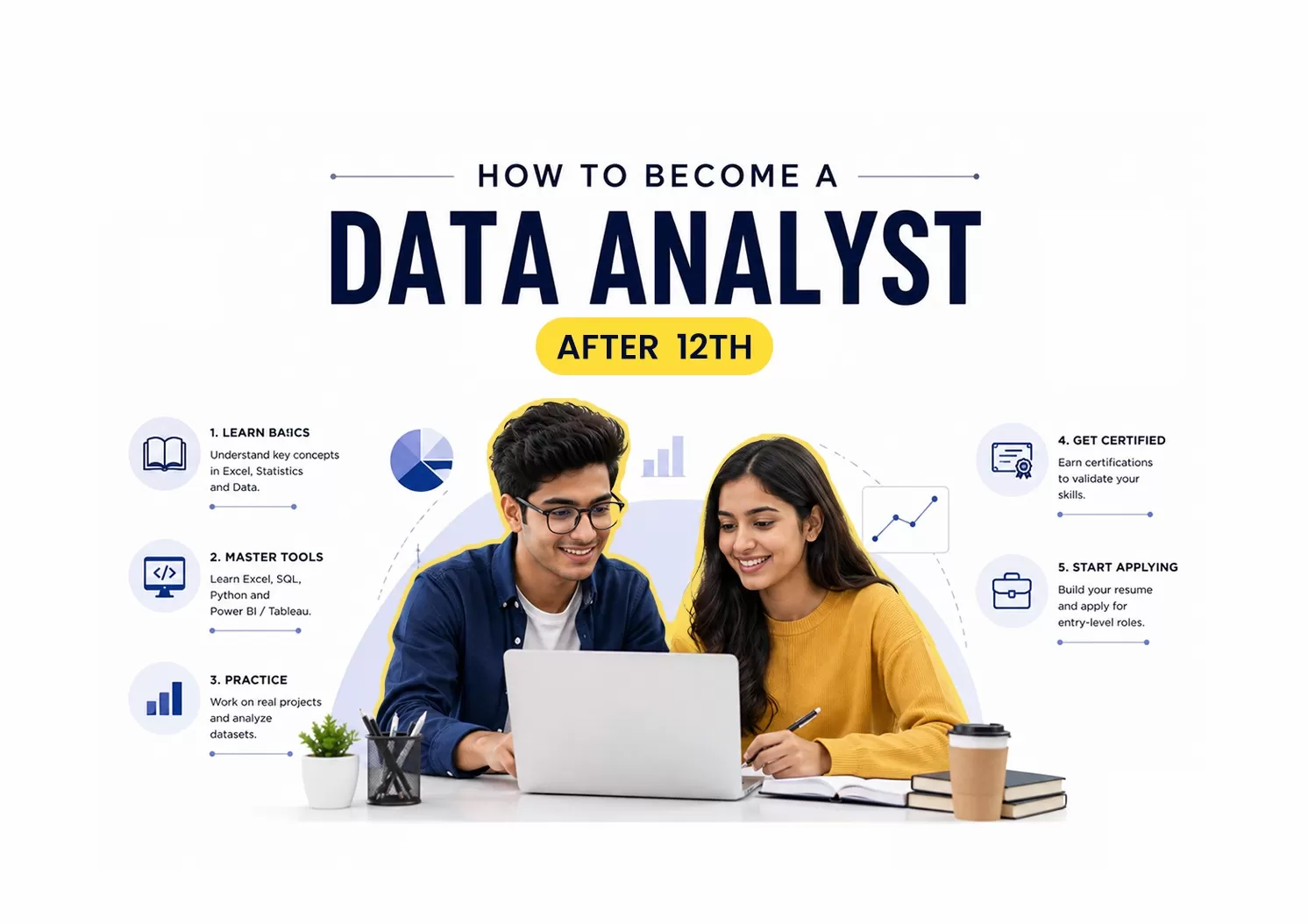
How to Become a Data Analyst After 12th – No Matter Your Stream
You just finished 12th. Everyone talks about engineering, medical, or government jobs. But numbers, patterns, and logic light up your brain. You’ve heard of “Data Analyst” and wondered: “Can I do that? From my stream?” Yes, you can. Science, Commerce, or Arts—every stream can lead to a data career. You don’t need a special degree or to be a coding genius. You need curiosity, a plan, and a little guidance. At DreamDesk, we help students check their real interest first, then build a step-by-step roadmap to get job-ready—without wasting time.
What Does a Data Analyst Actually Do?
A data analyst is a detective. Companies sit on mountains of data sales, customer clicks, delivery times. You clean that data, spot patterns, and turn them into simple insights. Tools like Excel, SQL, and Tableau help you answer real questions: “Why are sales falling in Kolkata?” or “What products do students buy together?” It’s more about thinking than heavy coding.
Does Your Stream Matter?
-
Science (PCM/PCB): You already think with numbers. Fast start.
-
Commerce: You understand business and accounts. Add data skills, and you become a business analytics expert.
-
Arts: You understand people and stories. Data + empathy opens doors in media, policy, and user research.
Still unsure if data fits you? DreamDesk offers a quick interest-mapping session. We’ll help you see if this path matches your strengths—before you invest months.
Your Step-by-Step Roadmap
Step 1: Build the Basics (No Money, Just Time) Start with three free things:
-
Excel: Learn formulas, pivot tables. (YouTube: “Chandoo”, “ExcelIsFun”)
-
Basic Statistics: Mean, median, probability. [Khan Academy Statistics](https://www.khanacademy.org/math/statistics-probability) is free and brilliant.
-
The “Why” Habit: Ask questions about everyday numbers. Why did that café have a queue today? Curiosity is your real foundation.
Step 2: Pick a Degree That Keeps Options Open
You don’t need a “Data Science” label. Choose any degree that lets you build analytical thinking:
-
B.Sc. (Stats/Maths/CS/Economics), B.Com, BBA, B.A. (Economics, Sociology, Psychology, Journalism)
-
While studying, add data skills on the side. Don’t wait for the syllabus.
Step 3: Learn the Core Tools (One at a Time)
-
SQL: The language of databases. Free practice: [SQLZoo](https://sqlzoo.net/)
-
Python: Learn basics, then Pandas, Matplotlib. [Google’s Python Class](https://developers.google.com/edu/python) is a gentle start.
-
Tableau Public: Free tool to create dashboards. [Download here](https://public.tableau.com/)
Master these over 6–8 months, and you’ll be internship-ready.
Step 4: Build a Portfolio, Not Just a Resume
Create 3–5 projects using real datasets:
-
Analyse IPL stats.
-
Explore Swiggy restaurant ratings.
-
Use government open data from [data.gov.in](https://data.gov.in) or [Kaggle](https://www.kaggle.com/datasets).
Put them on GitHub with clear descriptions. This becomes your proof.
Step 5: Get a Recognized Certificate
The [Google Data Analytics Professional
Certificate](https://www.coursera.org/professional-certificates/google-data-analytics) on Coursera is beginner-friendly, trusted globally, and financial aid is available. It alone can open doors.
Step 6: Intern, Freelance, and Apply
Search “Data Analyst Intern” on Internshala, LinkedIn. Start freelancing small Excel or dashboard tasks on Upwork. Entry job titles: Junior Data Analyst, MIS Executive, Business Analyst.
Where DreamDesk Comes In
You might read all this and still think, “But what’s my first move? Will I even like this?” That’s exactly where DreamDesk helps. We don’t just hand you a generic list. We:
-
Map your interest to real career paths.
-
Design a personalized learning timeline based on your stream, time, and budget.
-
Guide you to the best free and paid resources, scholarships, and internship opportunities.
We’ve helped hundreds of students move from confusion to a clear, actionable plan—and many now work as analysts in top companies.
Frequently Asked Questions
Q1: Can an Arts student really become a data analyst?
Absolutely. Communication, storytelling, and critical thinking are superpowers in data analysis. Learn Excel, SQL, and basic Python, and you can work in media analytics, policy research, and more.
Q2: Is strong maths required?
No. Basic statistics and logical thinking are enough. These can be learned gradually.
Q3: Which degree is best after 12th?
No single degree. B.Sc. Statistics, B.Com, BBA, B.A. Economics all work. What matters is building data skills alongside.
Q4: How long until I’m job-ready?
With 10–15 hours per week, you can be internship-ready in 6–8 months. A full-time job might take 12–18 months with consistent project work.
Q5: Are free resources enough?
Yes. Many successful analysts started with free tools. DreamDesk helps you find the right ones and, if needed, connects you to affordable paid programs that speed up the journey.
Q6: What salary can a fresher expect?
Typically ₹3.5–8 LPA for freshers, growing quickly with experience.
Q7: What if I later realise data isn’t for me?
The skills you learn—Excel, logical thinking, basic coding—are valuable everywhere. DreamDesk’s interest-checking helps you decide early, so you don’t waste months.
Data analytics is not about the stream you came from. It’s about the curiosity you bring. Start small. Stay consistent. And if you need a clear map, DreamDesk is right here to help you draw it.
